
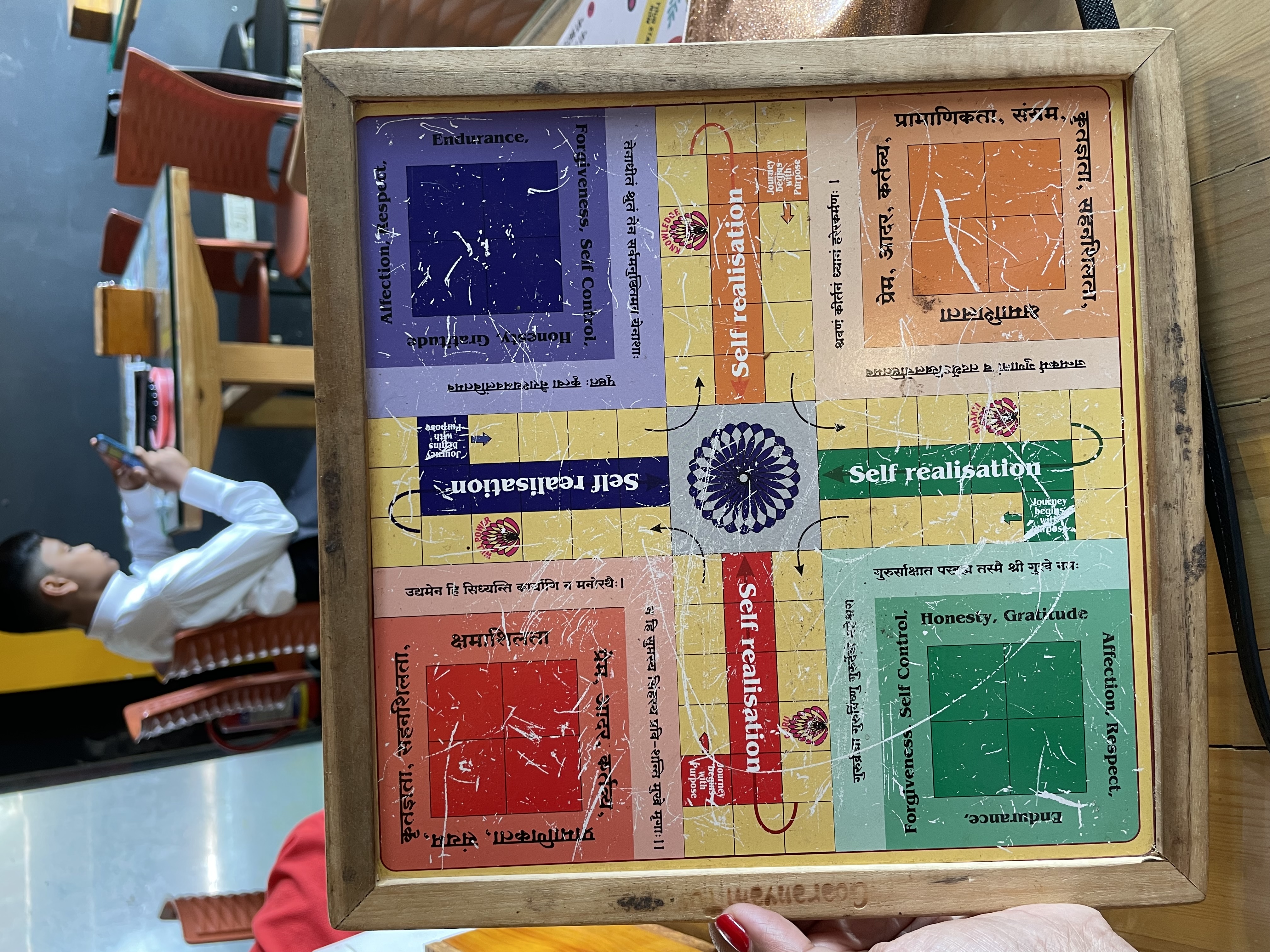
Some time ago, while waiting at a carwash, waiting for my car, I chanced upon this enlightened rendition of the board game popularly known as Ludo. The roots of this game can be traced to the ancient Indian game of Pachisi, or Chaucar and Choupad as they are colloquially known in contemporary India.
Origin & History

The earliest visual reference to this board game in India is from the 6th century CE, on the walls of Cave No 29 at Ellora, where Shiva and Parvati are depicted playing a game of Chaupad.

This board game was also very popular during the reign of Mughal Emperor Akbar (r. 1556-1605 CE). You can still catch a glimpse of Akbar’s fascination with this game at Fatehpur Sikri, the Emperor’s former capital in Agra. Here, he turned an entire courtyard into a magnificent, life-size board!

The modern version of Ludo was patented as ‘Royal Ludo’ by Alfred Collier in 1896 and is now known by different names in different countries, ‘Uckers’ by the Vritish Royal Navy, ‘Parcheesi’ in Spain, ‘Chatush Pada’ in China and ‘Ludu’ in Africa to name a few.
The Metaphor
As a child I remember getting frustrated playing this game with my siblings and cousins. It seemed so arbitrary and left to chance. You, at no point could think that you won due to your intelligence and hard work alone.
So why am i so intrigued with this rendition?? For me, I love that it is a simple and visual representation of the idea of the path to Enlightenment or Samadhi. Something that we normally speak about in an abstract way, but here is very literal and almost tangible making it a powerful tool reminding us of our true purpose in this life. So let’s have a look at what this board can teach us about our unique paths;
The game is played by two to four players, each having 4 colour coded beads or tokens. The game starts with a player rolling a dice which has six sides numbered one to six.
Rule: A player can only initiate movement of the token when they roll a six on the dice.
An aspirant is tested and given time to build their, endurance, forgiveness, self control, honesty, gratitude, affection and respect. These prerequisites remind me of Sage Pantanjalis ‘Yamas,’ moral codes and ‘Niyamas,’ self restraints that are rooted in Vedic tradition and the basis of Buddhist and Jain schools of thought.
When the aspirant is found eligible the teacher will give them ‘good advice’ and the ‘Guru Manta’ as a way to help them grow spiritually.
The text mentioned on this board are from the Hitopadesha or Shubhashit, literally meaning ‘good advice’. The ancient Sanskrit text, a collection of human and animal fables in pros, and is a timeless text on human behaviour and morals code. Spiritual masters give the Guru Mantra to their disciples during initiation. The Guru Mantra is a prayer that helps people develop faith in themselves. It can be interpreted as a way to see the light and follow the path of truth.
Hitopadesha Verse 0.36
udyamena hi sidhyanti kāryāṇi na manorathaiḥ |
nahi suptasya siṃhasya praviśanti mukhe mṛgāḥ || 36 ||
All work is accomplished by hard work and not by thinking. Just as animals like deer do not enter the mouth of a sleeping lion but the lion himself has to hunt, in the same way we should also work diligently to achieve the desired goal.
Guru Mantra
Om Om Om gurur brahmā gurur viṣṇur gurur devo maheśvaraḥ,
guruḥ sākṣāt paraṁ brahma tasmai śrī-gurave namaḥ.
Om, Om, Om. To that Guru who is Brahmā, the Creator, Viṣṇu, the Maintainer, and Śiva, the dissolver. To that Guru who is the direct experience of Brahman, salutations to that great guru.
Rule: There are specific tracks segmented into boxes where the tokens can travel. The result of the dice rolled decides how many boxes a token can travel. If the token lands on a star the player gets another turn
The path is long and meandering, and on it you flirt with fleeting glimpses of enlightenment, but it doesn’t seem to stick and is transient. The Sadhak perseveres and gets a boost/boon now and then when he; chances upon a guru, masters his willpower, is blessed with knowledge and practices Bhakti, devotion.
Rule: If a player meets another players token in the same box, the latter will have to return the token back to its home and start over.
I see the clash of tokens on the board as a representation of the clash of Egos and ideals in real life. The stripping of the ego in order to ascend on the path. As they say, the higher you climb the harder you fall.
Rule: A player wins when all his 4 tokens reach the final box or home.
And if all is favourable, situations in your control as well as outside, the Sadhak is able to reach their unshakable path towards self realisation. And ultimately Samadhi.
Even though you are at the mercy of your dice rolls, this game has excellent strategies to follow and win. The slowest player can win the game with patience and intelligence. It also teaches us life will not be the same all the time and to be patient and wait for your turn to take a step ahead.
Have you have played this before?
What does this board game mean to you?
Sources:
Board Games And What They Really Mean